
Losing lots of weight can feel like an enormous achievement. Clothes fit better, movement’s easier, and your body feels stronger and healthier. But there’s often an unexpected final hurdle: the weight’s gone, but the skin remains.
For some, this is especially noticeable around the inner thighs. Skin that once stretched to accommodate a larger body may be left loose and heavy, gathering when you walk or exercise. It can rub against itself, causing chafing and irritation, leaving you feeling like your legs don’t quite fit the transformation you’ve worked so hard to achieve.
Exercise can strengthen the muscles underneath. Losing more weight may reduce remaining fat. But neither can remove significant quantities of loose skin. That’s where a thigh lift can help. Let’s explore this surgical option.
Is a Thigh Lift Worth Considering After Major Weight Loss?
For someone who has spent months or years working towards their ideal weight, loose skin can feel like an unfair final obstacle.
You may have completely changed your lifestyle and transformed your body, only to discover that your inner thighs still rub together or that certain clothes are still uncomfortable.
That doesn’t mean your weight loss “didn’t work”. It just means skin behaves differently from fat.
A thigh lift is one option for dealing with that difference. By removing redundant skin and repositioning the remaining tissue, surgery creates a smoother contour. This smoothness is not only pleasing to the eye, but also reduces the physical discomfort that tends to come with excessive skin.
The decision is personal, and surgery isn’t appropriate for everyone. But if loose inner-thigh skin is causing you persistent chafing, discomfort or frustration despite reaching a stable weight, it may be worth discussing your options with a qualified surgeon.
What Is a Thigh Lift?
A thigh lift, also known as a medial thigh lift or thighplasty, is a surgical procedure that removes excess skin from the inner thigh and repositions the remaining tissue to create a far firmer, smoother contour.
The procedure is particularly popular for people whose skin doesn’t have quite enough elasticity to contract properly around the underlying tissues. This is common with:
- Significant weight loss
- Ageing
- Natural changes in skin elasticity
- Previous fluctuations in weight
- A combination of excess skin and localised fatty deposits
A thigh lift doesn’t simply make the thighs smaller. Its primary purpose is actually to address loose, unnecessary skin while improving the thigh’s shape and firmness.
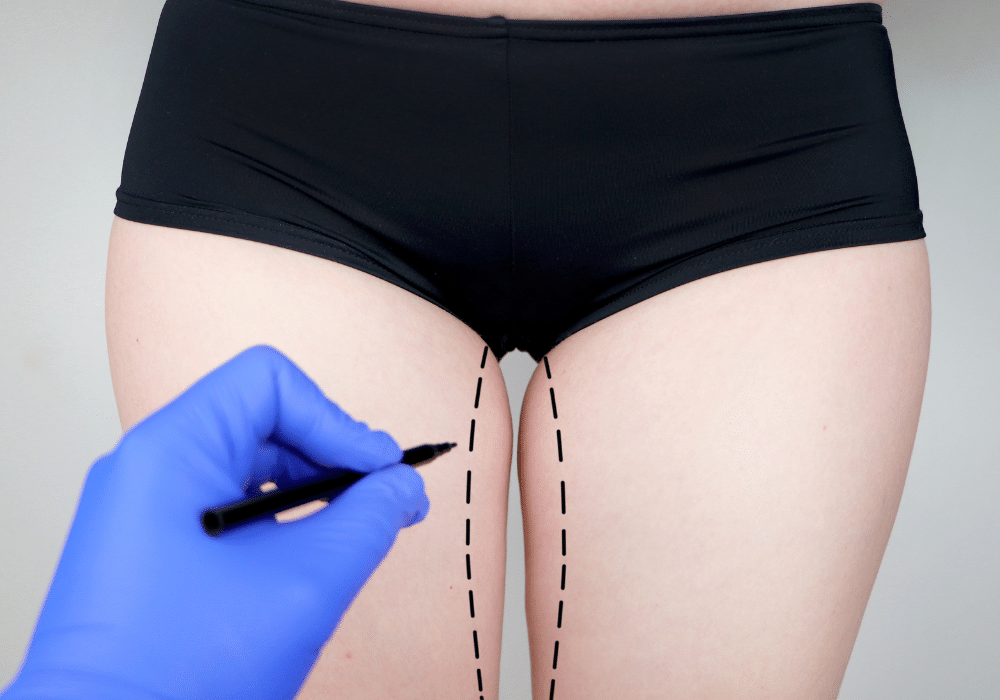
At Europe Surgery, the procedure focuses on the inner thigh. The incision is discreetly positioned along the natural crease of the groin and, where necessary, extends towards the buttock crease and down the inner thigh. The excess tissue is removed and the remaining skin lifted and re-draped upwards.
The result is a smoother, firmer silhouette, not an artificially tight look and feel.
Why Loose Skin Can Remain After Weight Loss
There’s a common assumption that if you lose enough weight, your skin will eventually shrink to match your new body.
Sometimes it does. But skin has limits.
When skin’s been stretched over a long period, its elastic fibres may lose the recoil needed to contract fully after weight loss. The result can be folds of skin that remain even when you’re at, or close to, your goal weight.
This can be particularly frustrating when you’ve done exactly what doctors and health professionals recommend: changed your diet, exercised regularly and lost the weight.
Yet you may still have skin that:
- Folds over the inner thigh
- Rubs against the opposite leg
- Causes chafing when walking
- Becomes uncomfortable during exercise
- Makes certain underwear or clothing difficult to wear
- Feels heavy or restrictive
- Affects how you feel about the shape of your legs
A thigh lift does not replace the benefits of weight loss. Rather, it addresses a problem weight loss itself can’t always solve.
Options for Fixing Sagging Thigh Skin
If you’re wondering how to fix saggy thigh skin, the first question to ask is whether you actually have loose skin, or if it’s excess fat. These are two different problems which require different approaches:
If the problem is primarily excess fat
Where the skin still has good elasticity and localised fat deposits are actually the issue, liposuction may be enough to improve the contour. This cosmetic surgery removes fat under the skin but doesn’t remove significant amounts of loose skin.
If the problem is primarily loose skin
A thigh lift removes the redundant skin and tightens the remaining tissue around the thigh. If loose thigh skin is your issue, a surgical thigh lift can be particularly useful.
If you have both loose skin and excess fat
Liposuction can be performed alongside a thigh lift where significant localised fatty deposits are present. Your surgeon will assess the amount and quality of both the skin and underlying fat before recommending the most appropriate approach.
What Happens During a Thigh Lift?
At Europe Surgery, a medial thigh lift is performed under general anaesthetic and takes approximately two hours. The operation involves several carefully considered stages:
1. The incision is planned
Your surgeon marks the areas of excess skin before surgery, taking into account your individual anatomy and the direction in which the remaining skin needs to be lifted.
The incision begins in the natural crease of your groin. Depending on how much excess skin needs to be removed, it can extend towards the gluteal fold and down the inner thigh.
2. Excess skin and tissue are removed
We surgically remove the redundant skin and, where appropriate, underlying fatty tissue.
The amount is determined by your anatomy, not some arbitrary target. Removing too much skin can create excessive tension, while taking too little may leave the original problem unsatisfied. Balance is important.
3. The remaining skin is lifted
Once the excess tissue is removed, the remaining skin is repositioned upwards, creating a smoother, firmer contour.
Europe Surgery uses a deep fascial anchoring technique to secure the elevated tissue to support the new position long term.
4. The incision is closed
We use deep absorbable sutures to close the wound, followed by surgical adhesive on the skin surface. This means there’s no need for conventional suture removal.
A compression garment is then applied to support the healing tissues and help minimise swelling.
Inner Thigh Lift Scar Placement: What Will the Scar Look Like?
Scarring is one of the biggest concerns for anyone considering a thigh lift – and we understand why, after you’ve worked so hard on your body.
A thigh lift is a surgical procedure, so some permanent scarring is unavoidable. That said, we position and manage the scar as discreetly as possible rather than pretending it won’t exist.
That is why, at Europe Surgery, we place the incision in the natural crease of the groin, where it can be easily concealed by underwear and swimwear.
For patients with more extensive excess skin, the incision may extend towards the buttock crease and down the inner thigh. The exact scar pattern depends on how much tissue needs to be removed and individual anatomy.
Initially, scars can be more visible than you expected, but this is normal during the early stages of scar maturation. Over the next few months, scars soften, flatten and fade. This process can continue for around a year.
Your surgeon should show you where your likely scars will be placed during your consultation, so you can make an informed decision before proceeding.
Thigh Lift Surgery After Weight Loss: Are You Ready for Surgery?
Timing matters. If you’ve just recently lost weight, it can be tempting to book body-contouring surgery immediately. However, your body needs time to settle.
At Europe Surgery, we recommend reaching a stable target weight before considering body contouring, and maintaining that weight stability for at least six months.
This is not about reaching a particular number on the scales. It’s about ensuring the body you’re having operated on is reasonably representative of the body you intend to maintain.
Significant weight changes after surgery may alter the result, potentially creating new areas of loose skin or changing the shape of the thighs. A healthy diet and regular exercise remain important both before and after surgery.
Who Is a Good Candidate for a Thigh Lift?
Do you have significant excess skin around the inner thighs that affects your comfort, clothing choices or confidence? You may be particularly interested in the procedure if you have:
- Lost a substantial amount of weight
- Loose skin that rubs or causes chafing
- Skin that hangs or folds around the inner thighs
- Good general health but persistent excess skin
- A stable weight
- Realistic expectations about what surgery can achieve
If your concern is primarily excess fat and you still have good skin elasticity, your surgeon may recommend liposuction instead. And if you are still significantly overweight or continuing to lose weight, it may be better to stabilise your weight before undergoing body-contouring surgery.
A consultation is therefore not simply about deciding whether you can have surgery. It’s about working out which procedure, if any, actually addresses the problem you have.
Thigh Lift Recovery: What to Expect
The first few days after surgery can be uncomfortable, as the inner thighs are involved in most everyday, ordinary movement.
Walking, sitting down and getting up can feel awkward initially. Swelling, bruising, tightness, and soreness are all normal parts of early recovery.
Which is why Europe Surgery asks patients to remain in Poland for six nights following surgery, allowing the medical team to monitor their recovery before they travel home. Here’s what to expect:
Day 1
You will remain in the clinic overnight following surgery. As the local anaesthetic wears off, soreness and stiffness can develop. You may find walking and sitting uncomfortable, so rest is important.
Days 2 – 6
The focus is on gentle movement, wound care and monitoring your healing. The nursing team will check your recovery during your stay and advise you on how to manage the compression garment and day-to-day activity.
Week 2
You should still be taking things carefully. Your ability to return to work will depend on the nature of your job and how your recovery is progressing. Anything that places significant strain on the inner thighs should be avoided until your surgeon says it’s safe.
Weeks 2 – 4
Gradually, everyday movement becomes easier, but the tissues are still healing beneath the surface.
Do not use feeling “fine” as a reason to rush back into strenuous exercise.
Months 2 – 6
Swelling continues to settle, and the contours become increasingly refined. Scars also begin their longer maturation process. The final appearance takes time. Your thighs may look considerably different from the first few weeks after surgery as swelling resolves.
How Much Does Thigh Lift Surgery Cost?
At Europe Surgery, thigh lift surgery starts from £2,280 as an all-inclusive package. Our package includes:
- Thigh lift surgery
- General anaesthetic
- One overnight stay in the clinic
- Daily post-operative consultations during your stay
- Compression garment
- Dissolvable sutures
You are asked to remain in Poland for six nights after surgery, which is longer than the initial overnight clinic stay and allows the team to monitor your recovery before you travel home.
As with any surgery abroad, it is important to look beyond the headline price and understand exactly what is included, what happens if you experience a complication and what follow-up support is available once you return to the UK.
Frequently Asked Questions About Thigh Lift Surgery
Can a thigh lift remove loose skin after weight loss?
Yes, it’s what the procedure’s designed for! A medial thigh lift specifically removes excess, sagging skin from the inner thighs and is particularly useful after significant weight loss when skin can no longer fully retract.
Will a thigh lift get rid of thigh fat?
Not necessarily – the primary purpose of a thigh lift is to remove excess skin. Where localised fatty deposits are also present, we recommend considering liposuction alongside the thigh lift.
Where is the scar from an inner thigh lift?
The incision is placed along the groin’s natural crease and may extend towards the buttock crease and down the inner thigh, depending on how much excess skin needs to be removed.
How long do I need to stay in Poland after a thigh lift?
At Europe Surgery, we ask patients to remain in Poland for six nights after the procedure, including the overnight clinic stay. This allows the medical team to monitor your recovery before you travel home.
How painful is a thigh lift?
Some soreness, stiffness, swelling and bruising are expected after surgery. The inner thighs are involved in many everyday movements, so walking and sitting will be initially uncomfortable. Prescribed pain relief can help manage post-operative discomfort.
When will I see my final thigh lift results?
Changes are immediately visible because the excess skin’s gone, but swelling can obscure the final contour during the early recovery period. The shape settles over the following months, while scars can take around a year or longer to fully mature.
Can a thigh lift stop chafing?
If the chafing’s caused by folds of excess inner-thigh skin rubbing together, yes, removing the extra tissue may reduce this mechanical friction. However, individual results depend on the amount and location of excess skin and your underlying anatomy.