

Hair loss can feel deeply personal. Whether it’s a receding hairline, thinning crown or widening parting, it often affects how we see ourselves.
At Europe Surgery, we see firsthand how a hair transplant can restore not just hair, but confidence. If you’re researching your options, this guide explains exactly how a hair transplant works, what to expect at every stage, and how to achieve the best long-term results.
In this guide, we’ll cover:
- What is a hair transplant?
- How does a hair transplant work?
- Do hair transplants work?
- Does a hair transplant hurt?
- Do hair transplants for women work?
- How long does a hair transplant last?
- Patient aftercare and recovery after a hair transplant
- Who can have a hair transplant?
- How much does a hair transplant cost?
- How to find the right hair transplant clinic
- Reviews
- FAQs about how FUE works
What is a Hair Transplant?
A hair transplant is a minor surgical procedure that moves healthy hair follicles from one part of your scalp (the donor area, usually the back or sides of the head) to areas experiencing thinning or balding (the recipient area).
The reason this works is simple but powerful: hair at the back and sides of the scalp is typically genetically resistant to balding. When those follicles are relocated to thinning areas, they retain that resistance – meaning they continue to grow long-term.
There are two primary techniques to achieve this:
- FUE (Follicular Unit Excision) – Individual follicles are extracted one by one.
- FUT (Follicular Unit Transplantation) – A strip of scalp is removed and dissected into grafts.
FUE is the most popular option in 2026, due to its minimal scarring and faster recovery. Here at Europe Surgery, we offer FUE hair transplant surgery to encourage as much new hair growth as possible.
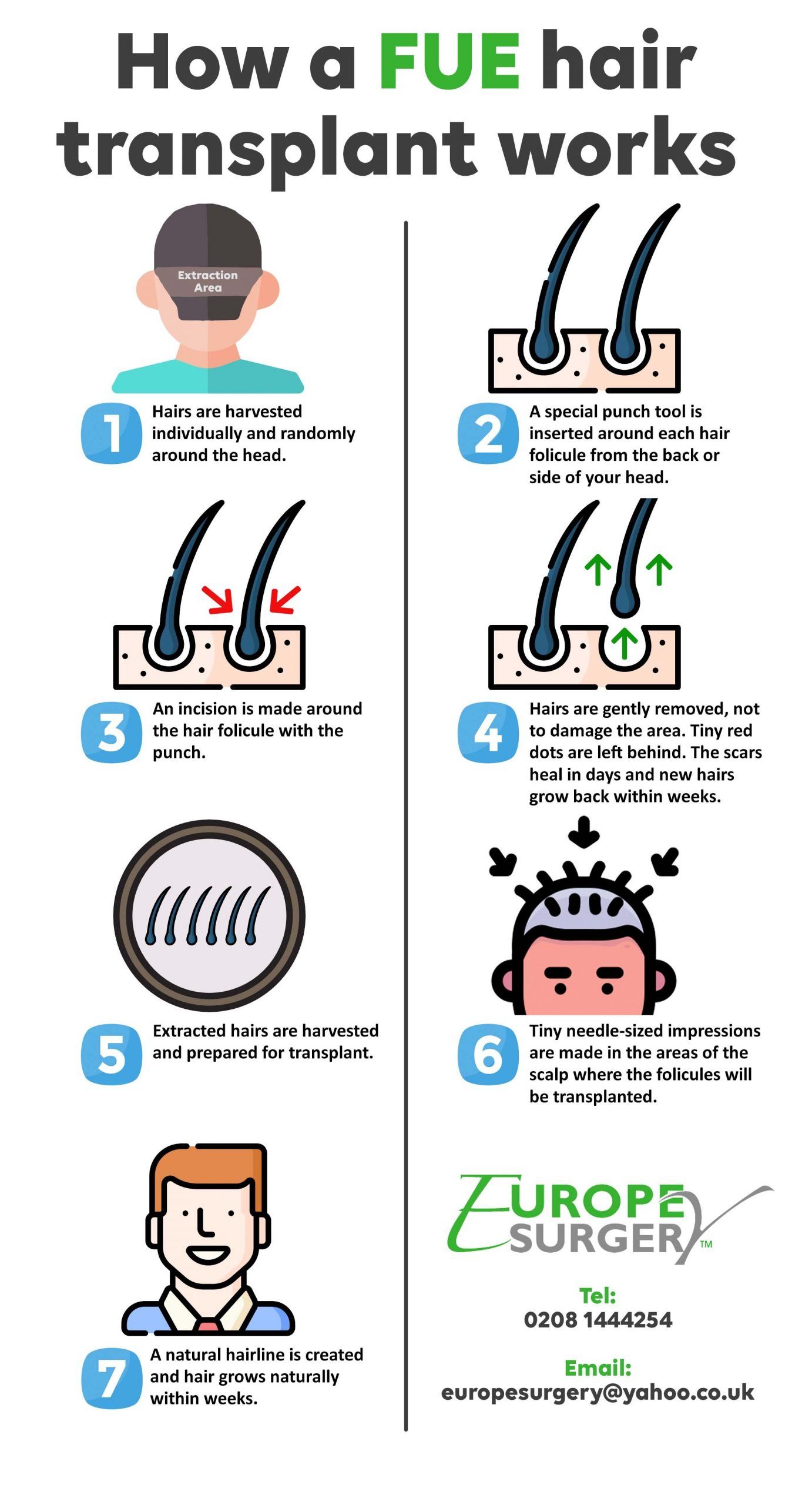
How Does a Hair Transplant Work? (Step-by-Step)
Anxiety and uncertainty are very natural when making a change, and understanding the process can reduce a lot of that uncertainty. So, here’s how the FUE hair transplant procedure works:
1. Consultation & Hairline Design
Before any surgical procedure, your surgeon assesses your hair loss pattern, donor density, and long-term plan. A natural-looking hairline is carefully designed to suit your face and age (not just your current preference).
2. Preparing the Donor Area
The back or sides of your scalp are trimmed. A local anaesthetic is applied so you won’t feel discomfort during the extraction.
3. Follicle Extraction
Using a precise micro-punch tool (typically less than 1mm in diameter), individual follicles are gently removed. Each graft usually contains 1 – 4 hairs.
The key here is precision, because over-harvesting or poor technique can damage donor density. In other words, genuine surgical expertise is crucial.
4. Graft Preparation
The extracted follicles are carefully inspected and preserved in a controlled solution to maintain viability. Only healthy grafts are prepared for transplantation.
5. Creating Recipient Sites
Tiny, needle-sized incisions are made in the thinning area. The angle, depth and direction of these sites determine how natural your final result will look.
6. Graft Placement
Each follicle is meticulously placed into the tiny prepared sites, which can accommodate up to four follicles. This stage requires patience and an artist’s hand to ensure density and natural hair growth patterns.
7. Healing & Growth
Initially, the transplanted hairs shed within the first few weeks (this is completely normal and is no cause for concern). New, real growth begins around 3 – 4 months post-procedure, with visible improvements by 6 months and full results typically visible at 12 – 18 months.
Do Hair Transplants Work?
Absolutely! Hair transplants work and have restored the confidence of many men and women. You do need to follow your surgeon’s advice and learn how to sleep after a hair transplant, as around 80% of hair transplant failures are due to incorrect sleeping positions. But if you follow our advice carefully, your hair density should be well improved.
You can view some hair transplant before-and-after pictures to see the amazing impact the procedure can have.
Does a Hair Transplant Hurt?
No, a qualified surgeon should use a local anaesthetic before the operation. That means you won’t experience any discomfort or pain during the operation.
Do Hair Transplants for Women Work?
Yes. Lots of women often have a hair transplant with Europe Surgery and experience plenty of benefits, including:
- Boost in confidence
- Far less bald patches
- Natural appearance physically
- Improved self-esteem overall
How Long Does a Hair Transplant Last?
The results of a hair transplant can last for years and, in fact, often last for 20 years or more. If you’re on medication to reduce the effects of hair loss, this will help as well.
Who Can Have a Hair Transplant?
Anyone with some healthy hair follicles can have a transplant, as their hair is likely to remain healthy post-op. Men who suffer from male pattern baldness often choose to have a transplant. Since a successful hair transplant relies on healthy donor follicles, a transplant can be tricky with complete baldness (Norwood 6 – 7 stages), but not impossible.
How Much Does a Hair Transplant Cost?
It can be as affordable as £2,400 with Europe Surgery. This is how much a hair transplant costs in detail.
How to Find the Right Hair Transplant Clinic
Choose a qualified surgeon if you’re investing in a hair transplant operation.
Our surgeon has been qualified for over 25 years and has trained doctors from many countries worldwide to improve their procedures. Dr Marwan Saifi specialises in correcting poorly performed hair grafts and has achieved the Fellow designation of the International Society of Hair Restoration Surgery (FISHRS).
FAQs About How FUE Works
Do hair transplants work?
Yes. The hair transplant procedure is often much more effective than the existing hair restoration products you can buy over the counter.
Can you get hair implants in the UK?
You can get hair implants in the UK, but it tends to be far more expensive than at our clinic in Poland, and the expertise of the surgeon will not equal ours.
How much do hair implants cost in the UK?
Hair implant surgery in the UK can cost up to £10,000, according to the NHS, making travelling to Poland for surgery often much cheaper. Hair transplant surgery can be as cheap as £2,400 when you choose us.
How does FUE hair transplant work?
FUE hair transplant is follicular unit extraction. It’s one of the modern types of hair transplantation surgeries.
Does FUE hair transplant work?
Yes, FUE hair does work. We have many happy patients after their FUE surgery with us.
Does hair transplant hurt?
No. Hair transplants don’t hurt if you choose the right surgeon. Make sure the surgeon you choose has the right qualifications and experience to do the hair transplantation surgery.
Also check the surgeon’s testimonials. Take a look at what other previous patients say about their experience with the surgeon. Are they happy with their results?
Can you get hair transplants for men?
Yes, you can get hair transplants for men. Hair transplants and implants refer to the same topic. We perform hair transplants on men and women of varying ages.
Can it help prevent future hair loss?
Yes, it can help prevent future hair loss from the newly transplanted hair, which is what many people love about follicular unit strip surgery – they get new, healthy hair after their follicular unit extraction (FUE). But it won’t prevent the non-transplanted hair from hair loss.
Discover latest blogs